30 days free to organize your business in Japan.
Start freeDon't pay tax on the money you spent to do your work.
Photograph your receipts. Record what you were paid. eKOJINjp organizes it and shows what's really left — built for people working for themselves in Japan.
30 days free. No credit card.
Works on phone and computer. Add it to your home screen and use it as an app.
Keeping receipts in a box is not bookkeeping.
Thermal receipts that fade over time
Blurry, cropped or incomplete photos
Documents lost in the rush
Expenses you forgot to record
Information scattered across spreadsheet, phone and paper
Hard to find one specific document
No history of what was changed
Personal and business spending mixed together
The more time passes, the harder it gets to reconstruct what happened.
You received ¥4,000,000. That isn't what you earned.
Whoever pays you may report to the tax office how much they paid. If you didn't record what you spent to earn it, you have no way to show it.
Without receipts, the conversation starts at ¥4,000,000. With them, it starts at ¥2,000,000 — and there are still personal deductions plus, for anyone filing the 青色申告, up to ¥650,000 more.
These figures are an example. How much you spend, what is accepted and what's left depend on your case: not every expense is deductible and not every receipt is accepted.
From receipt to bookkeeping entry, all connected.
Scan the receipt
Photograph or upload it while it is still readable. The app reads the details for you to confirm.
Link it to the entry
The document stays attached to the matching income or expense — not lost in your phone gallery.
Preserve the history
Details, changes and documents stay organized and searchable for later.
A photo of a receipt doesn’t tell the whole story.
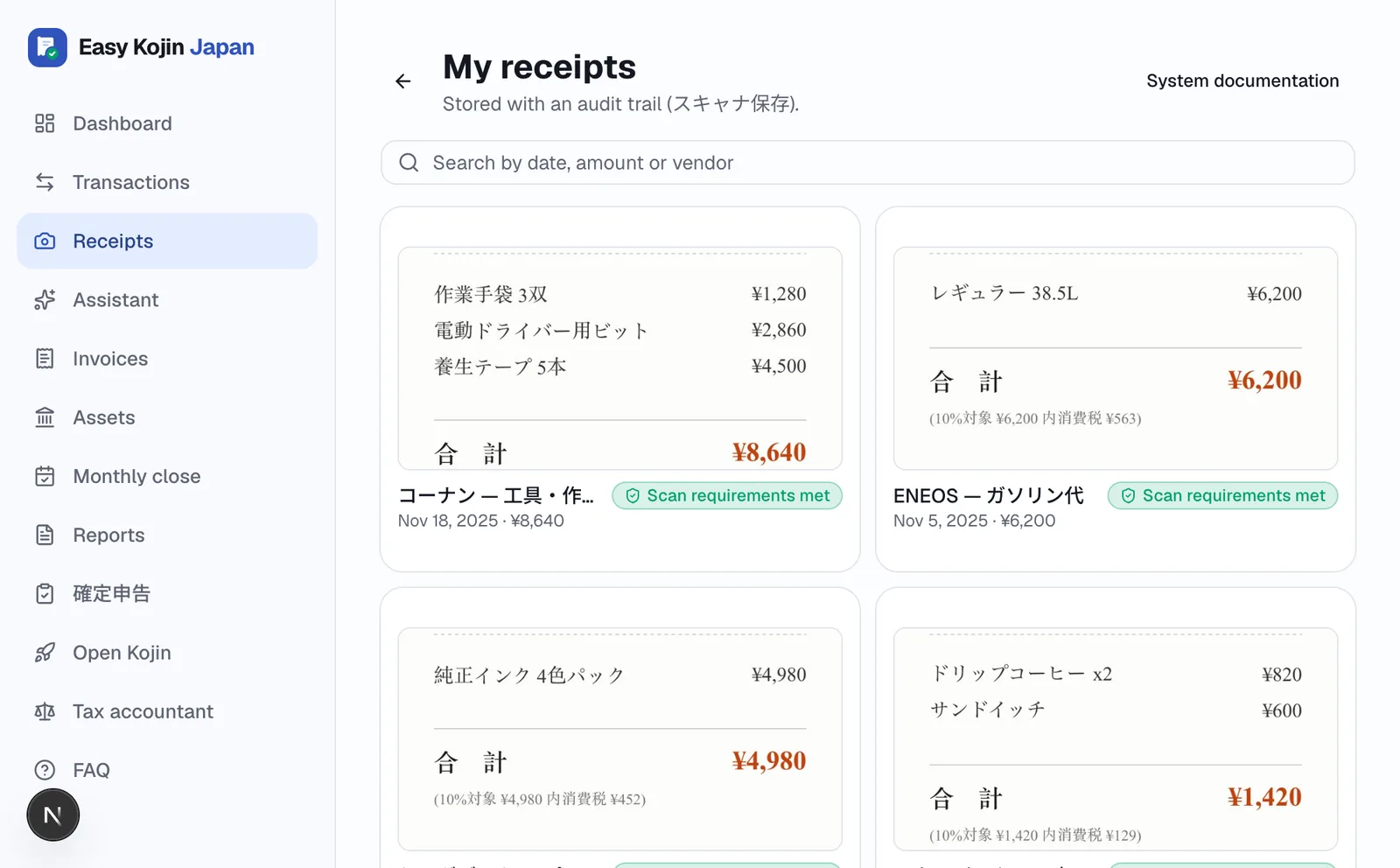
eKOJINjp goes beyond storing images. The document stays attached to its bookkeeping entry, with organized details and a history of changes. That creates traceability and makes it easier to find, check and explain every movement.
Document linked
Every receipt is tied to its bookkeeping entry.
Change history
Creation, edits and deletions are recorded automatically.
Fast search
Find by date, amount or vendor in seconds.
Integrity preserved
The system won’t let a document be erased without a record.
Requirements checked
The app checks color, resolution and scanning deadline per receipt.
Electronic documents
PDFs received by e-mail can be archived too (電子取引).
What actually changes
Simple finance app
- An isolated photo in the gallery
- Document not linked to the entry
- Limited or no history
- Hard to tell what changed
- Information scattered
eKOJINjp
- Document linked to the entry
- Organized, searchable details
- History and traceability
- Central search by date, amount and vendor
- A flow designed for freelancers in Japan
A capability many simple finance apps don’t offer.
How documents must be handled and kept depends on the legal requirements applicable to each situation. eKOJINjp helps you organize and trace your information, but does not replace individual tax advice.
Saving a photo of the receipt is not enough.
For スキャナ保存 (電子帳簿保存法), Japanese law asks for more than an image on your phone: the document must be findable by date, amount and vendor, scanned within a deadline, in adequate color and resolution, and with a history of corrections and deletions. eKOJINjp was built around those points.
Search by date, amount and vendor
The three fields the rule requires to locate a document.
Scanning deadline
The app flags whether the receipt was scanned in time.
Color and resolution
A receipt is 重要書類 (important document): color image and adequate resolution.
History of corrections and deletions
The alternative to a certified timestamp foreseen in the rule.
System documentation
The 事務処理規程 (internal procedures policy) is available inside the app.
電子取引 (electronic transactions)
PDFs received by e-mail kept in electronic form.
Requirements per the 国税庁 (Japan's National Tax Agency) official material on 電子帳簿保存法 (Electronic Books Preservation Act) / スキャナ保存 (scanned document archiving).
Less time searching. More time working.
Find documents faster
Avoid losing important expenses
Track income, expenses and result
Separate personal from business
Reduce the year-end pile-up
Understand your business better
Organize information for your accountant
Respond to requests with confidence
Preserve your document history
Arrive prepared at filing season
Paper, spreadsheet — or a process?
Each solves a part. Only one keeps document, information and history together.
| Box of receipts | Spreadsheet | eKOJINjp | |
|---|---|---|---|
| Records the numbers | ✕ | ✓ | ✓ |
| Keeps the document | ✓ | ✕ | ✓ |
| Links document to entry | ✕ | Partial | ✓ |
| Lets you find it fast | ✕ | Partial | ✓ |
| Preserves change history | ✕ | ✕ | ✓ |
| Survives time (doesn’t fade) | ✕ | ✓ | ✓ |
Your business dashboard, in your language.
Income, expenses, result and the year’s tax estimate — updated with every entry, with Japanese terms always translated.

Organization for Blue and White Return filers.
eKOJINjp keeps income, expenses and documents organized all year. If you want the benefits of the 青色申告 (Blue Return), keeping consistent records matters especially.
青色申告 (Blue Return)
Double-entry books (仕訳帳 and 総勘定元帳) you can export, plus the official forms filled with your figures.
白色申告 (White Return)
The official 収支内訳書 (statement of income and expenses) generated from your entries for the year.
eKOJINjp organizes and prepares your information. Approval, deductions and acceptance of documents depend on the applicable rules and your situation.
What changes day to day
Before
- Receipts in a shoebox
- Photos scattered on the phone
- Different spreadsheets, different versions
- Unsure which category to use
- No idea of the real monthly result
- A scramble in February and March
After
- Centralized, searchable documents
- Receipt linked to the entry
- Transactions categorized in Japanese and your language
- History preserved automatically
- A clear view of income, expenses and result
- A tax return prepared calmly
Built for people working for themselves in Japan.
If you are a 個人事業主 (Kojin Jigyou) or just starting out, eKOJINjp was designed around your routine.
Your documents, under your control.
Per-account isolation
Each user sees only their own data, enforced at the database level.
Private storage
Receipts live in closed storage, reachable only through temporary links.
Deletion with a record
Documents never vanish without history — that is what gives traceability.
Your data is yours
Export everything whenever you want, or delete your account and the data with it.
Simple, transparent pricing
Start with 30 days free on the Full plan. Then pick what fits — no lock-in.
Basic
Everything to keep your day-to-day books in order.
- Unlimited entries + tax dashboard
- 20 receipts per month with automatic reading (OCR)
- Recurring, statement import and CSV export
- PDF report, 確定申告 (annual tax return) assistant and reminders
Full (with AI)
Everything in Basic, unlimited, with invoices and AI.
- Everything in Basic, unlimited
- Unlimited receipt OCR
- Issue 請求書 (qualified invoices)
- AI tax Q&A chat, 24h
30 days with every feature · The subscription is deductible as a business expense
30 days to get your business bookkeeping in order.
Included in the free period:
- Income and expense records
- Digital receipt archive
- Documents linked to entries
- History and audit trail
- A financial view of your business
- Features specific to 個人事業主 (registered sole proprietor in Japan)
- Everything in Portuguese, Japanese or English
Organize today what you’ll need to explain tomorrow.
Need to open/register your Kojin?
We help you file the business registration (開業届), in Portuguese, from start to finish. For ¥5,000 you also get 6 months of the Full plan.
Open my KojinNeed to file your tax return?
Easy Kojin organizes your books but doesn't file for you. We connect you to a partner tax accountant (税理士), with Portuguese-speaking support. Filing fees are separate.
Still unsure?
I don’t understand accounting.
The app shows your records simply, explained in your language, with Japanese terms always translated alongside.
I already use spreadsheets.
Spreadsheets help with the math, but they tend to leave receipts, documents and history separated from the record.
Can I start mid-year?
Yes. You can start today and add earlier transactions as needed.
Do I have to drop my accountant?
No. eKOJINjp organizes the information, which usually makes preparing and talking with your professional easier.
Can I throw the paper receipts away?
Only once the applicable procedures and legal requirements are met. The app shows whether the scan meets the technical requirements, but the decision depends on your situation — confirm with a 税理士 (licensed tax accountant in Japan).
Is it complicated to start?
No. Sign-up is short and a guide walks you through setting up your business, your first entry and your first receipt.
Guides for people working for themselves in Japan
Straight answers on the decisions that cost the most money.
Frequently asked questions
What is eKOJINjp?
An app for bookkeeping and document organization for people working as 個人事業主 (self-employed) in Japan. It brings income, expenses and documents together, in Portuguese, Japanese or English.
Who is it for?
Freelancers, self-employed people, service providers and small business owners in Japan — especially foreigners who struggle with Japanese accounting terminology.
What is an audit trail?
An automatic record of what happened to each piece of information: when it was created, what changed and when. It preserves the history and makes it easier to explain any movement later.
How are receipts stored?
You photograph or upload the document; it is kept in private storage, linked to its bookkeeping entry, searchable by date, amount and vendor.
Does the system meet スキャナ保存 (scanned document archiving) requirements?
eKOJINjp is organized around the applicable スキャナ保存 (scanned document archiving) requirements (color image, resolution, scanning deadline and change history) and shows, per receipt, whether the technical requirements were met. Full compliance also depends on your own procedures and situation — the app does not provide a legal opinion.
What are electronic transactions (電子取引)?
Documents you already receive digitally, such as a PDF by e-mail. Under the current rule they must be kept in electronic form — eKOJINjp lets you archive PDFs alongside your other receipts.
Can I discard the physical documents?
Only once the applicable legal requirements are met. The app shows whether the scan meets the technical requirements, but the decision to discard depends on the document type and your situation. Confirm with a 税理士 (licensed tax accountant in Japan) first.
Does eKOJINjp replace an accountant?
No. It organizes and prepares the information, which usually makes the professional’s work easier (and cheaper). If you prefer, we can refer you to a partner 税理士 (licensed tax accountant in Japan).
Can I use it for the 青色申告 (Blue Return)?
Yes. It keeps your records through the year and exports double-entry books (仕訳帳 and 総勘定元帳), plus the official forms pre-filled.
Can I use it for the 白色申告 (White Return)?
Yes. The official 収支内訳書 (statement of income and expenses) is generated from your entries.
Is my data protected?
Each account only sees its own data, isolated at the database level. Receipts are kept in private storage, reachable only through temporary links. You can export everything or delete your account at any time.
How long does it take to start?
A few minutes. Sign-up asks only for e-mail and password, and a short guide helps with the first steps.
How long is the free trial?
30 days, with access to the Full plan features.
Do I need a credit card?
No. The free period starts with no card and no automatic charge.
What happens after the 30 days?
You pick a plan to continue. If you don’t, access is paused — your data stays stored and you can export it.
Your next receipt can already come in organized.
Start now and turn scattered documents into a bookkeeping routine that is simpler, traceable and safer.
Try free for 30 daysMore organization today. More peace of mind at filing time.